After 13 hours of discussion, the Saeima, Latvia’s parliament, voted last autumn to retreat from Europe’s leading human rights treaty for preventing and combatting sex force – the Istanbul Convention.
Immediately following what many Latvians described as a abrupt and shocking decision, thousands of protesters poured into the streets of Riga to express their anger and frustration.
The opposition parties that spearheaded this vote included the National Alliance, For Stability! and Latvia First. Experts have noted that as the October 3rd election approaches, these parties are looking for issues, like the Istanbul Convention, that they can usage to gain more seats in parliament.
“It’s rather virtually just an election year, and 1 organization has decided that it wants to prosecute 1 of those sorts of divisive elements,” said Kate Kanasta, a political discipline PhD student at the University of Latvia. “And they definitely succeeded.”
What is the Istanbul Convention?
The Istanbul Convention, formally known as the Council of Europe Convention, created a legal framework to prevent and combat force against women, including home violence. The treaty clearly defines terms, including force against women, home violence, sex and gender-based violence. It is enforced by an independent organization called “The Group of Experts on Action against force against Women and home Violence”, which evaluates each country’s advancement and publishes reports that describe how states are implementing the convention’s provisions.
A narrow majority of the Saiema voted to sign the Istanbul Convention in May 2024, joining 21 another European countries in a commitment to combat sex violence. The agreement was accompanied by a declaration that said the convention would be applied in line with the Latvian constitution.
Latvia has any of the highest rates of home force in the European Union. about 30 per cent of women have experienced intimate partner force since the age of 15, according to official data. Physiological force is the most common kind of intimate partner violence, with 29 per cent of women experiencing it. At the same time, physical force has been experienced by 15 per cent of women.
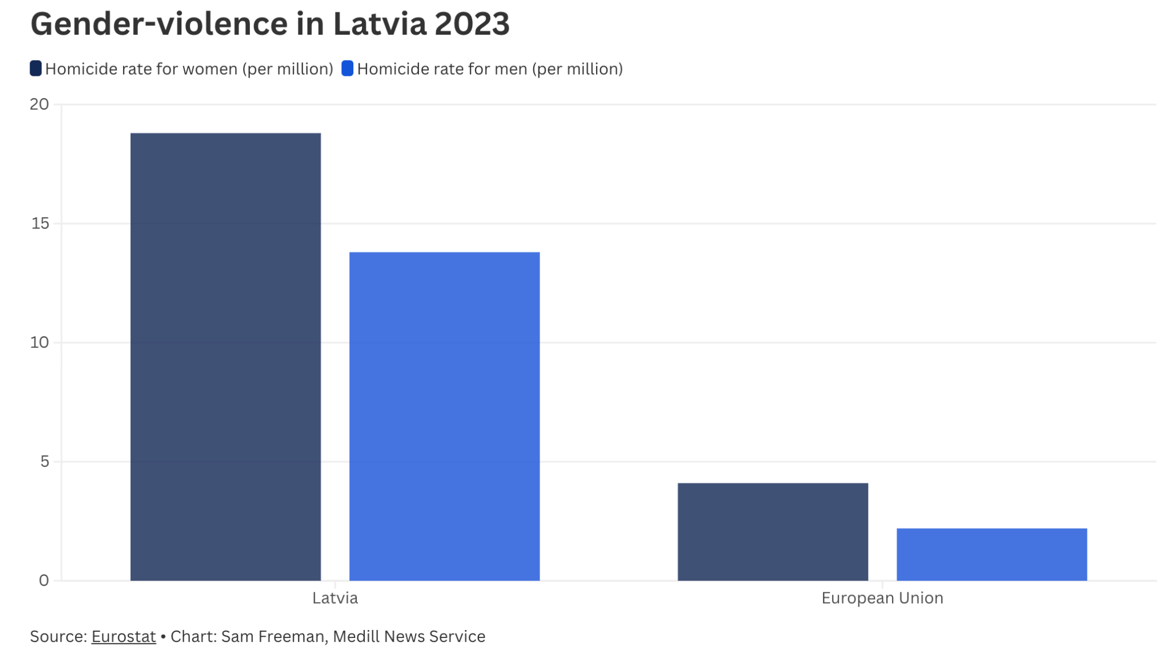
In Latvia, 18.8 women in all 1 million were victims of intentional homicide by household members or intimate partners — a rate that is 4 times higher than the EU average. (Flourish graphic by Sam Freeman)
Since the Istanbul Convention was created in 2014, 45 countries have signed the Council of Europe Convention. Latvia would be the second country to leave the convention, after Turkey, which withdrew from the convention in 2021.
Warping the communicative
The opposition parties of Latvia First, National Alliance, and For Stability! presently hold 33 seats out of 100. erstwhile these groups, along with the coalition-affiliated Union of Greens and Farmers, voted to leave the Istanbul Convention, they dismissed Latvia’s issue with gender-based force in an effort to formulate a political platform opposing the parliamentary majority.
“Two years have passed since the adoption of the Istanbul Convention. And what precisely are the reduced force rates as a consequence of the adoption of the Istanbul Convention? I don’t see it,” said Linda Liepiņa from Latvia First during discussions on October 30th last year. “What I see is how a abroad ideology is creeping into our everyday lives.”
Liepiņa besides expressed regret for backing the ratification of the convention and expressed disapproval for what she called “gender benders”.
“Since they’re the opposition, they’re looking for ways to show to their voters’ activity, and they don’t have very much productive content to demonstrate,” said Evija Djatkovica, the deputy manager of the Center for Geopolitical Studies Riga. “So they’re looking for any popular issues.”
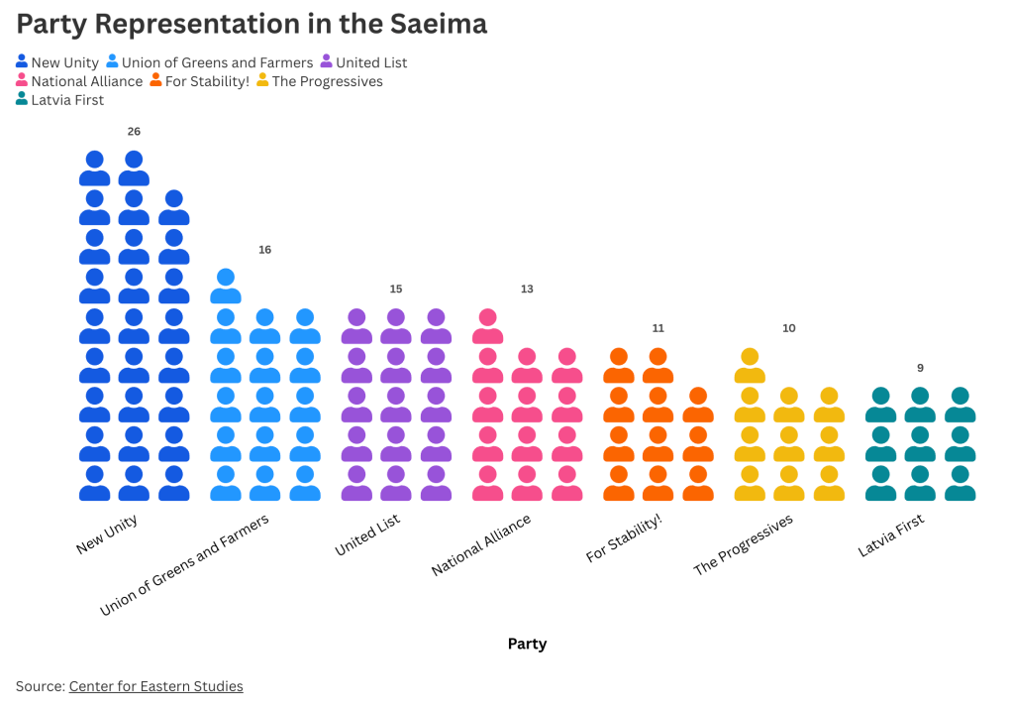
Graph showing the current number of representatives from each organization in the Saiema that was elected in October 2022. (Flourish graphic by Sam Freeman)
By claiming the Istanbul Convention is “too western” and against the family, the opposition parties have positioned themselves as pro-family values, appealing to 1 of the most crucial and widely held attitudes in Latvia.
According to International technological Publications, more than half of Latvians favour a marriage-based, conventional lifestyle. That number is even greater for people who are older, Russian-speaking, and surviving outside Latvia’s urban regions.
These cultural divisions are a byproduct of the country’s erstwhile business by the russian Union, which left it with a Russian-speaking minority.
For more than 20 years, the Latvian government has made efforts to make a unified Latvian national identity. It besides has powerfully backed Ukraine’s defence against Russian aggression. However, any related issues are changing as the parliamentary election approaches. According to Madura Kanasta, a programme coordinator at the Marta Center, Latvia’s leading women’s organization, conservative parties are employing these divisions for political gain by claiming the convention is damaging. For transparency, it is worth noting that Madura Kanasta and Kate Kanasta are sisters.

Evija Djatkovica, the deputy manager of the Center for Geopolitical Studies Riga and the head of the Belarus and East-Europe programme, says the opposition parties utilized the Istanbul Convention to establish a political platform that contrasts with average and progressive groups. (Medill Illinois News Bureau photograph by Sam Freeman)
“This has always been the issue – that someway the Istanbul Convention would harm the conventional values of family, of women and men as the basis of the family, all due to the word “gender”,” said Madura Kanasta.
The centre, established 25 years ago, began with a mission of women’s empowerment and entrepreneurship skills. Now, it focuses on gender-based violence, working with adult victims by providing consultations and apartments for victims of home violence. It besides works in policy advocacy. Representatives of the group were present at discussions on October 30th, the day the Saeima voted to leave the Istanbul Convention.
“We are hosting conferences, going to parliament, going to ministries, constantly participating in fresh regulations and laws,” said Madura Kanasta. “We are always there.”
Lingering Russian influence
One of Madura’s primary roles at the Marta Center is education and ensuring that youth and young adults have access to accurate, reliable information. This is due to the fact that Russian media continues to influence people in Latvia, attempting to change public perception on issues ranging from the Ukraine-Russia war to the Istanbul Convention.
“It’s definitely besides coming from Russia due to the fact that they have utilized [media] for ages to influence the discourse that is in the region, how the planet is changing, how the West is damaging, and so on,” Madura Kanasta said.
According to Edgars Baldunčiks, the chief of staff for the centre-right fresh Unity party, Russian media is most effective in regions where there are Russian-speaking majorities, specified as the city of Rēzekne. fresh Unity is the largest political organization in Latvia and voted against withdrawing from the Istanbul Convention last autumn.
In the tiny city of Rēzekne close the Russian border, residents regularly see online opposition to the Istanbul Convention.
“We have here different organizations who are pushing this information against the Istanbul Convention. So it’s similar, like the information about war. The information from Russia is talking about these things, too,” said Diana Selecka, a lifelong resident of Rēzekne.
In this city, only 50 kilometres from the Russian border, nearly half of people identify as ethnically Russian and talk Russian as their primary language at home. Experts say that Russian speakers tend to hold more conventional values compared to cultural Latvians and especially those surviving in Riga.
However, Selecka says even in Rēzekne, most all person, including herself, defends women’s rights in addition to conventional household values.
“I defend conventional household values but am not against the Istanbul Convention,” Selecka said.
According to the Marta Center, most Latvians support women’s rights from Riga to Rēzekne. Overall, they are simply exposed to different information spheres. Due to this, the Marta Center has expanded to regions outside of the capital and works to debunk claims by opposition parties that the Istanbul Convention is antithetical to household values.
Concern over another progressive policies
Progressives fear the Istanbul Convention may be the first of respective progressive policies targeted by opposition parties trying to rally support ahead of the election.
“They were investigating the ground, and this was the [issue] that got momentum,” Madura said. “Probably till the election, something else will come up.”
Madura said she was most afraid about attacks on LGBTQ rights. Although gay matrimony is not legal in Latvia, same-sex couples can registry their partnership through a notary, providing legal, social and economical protections.
“LGBTQ issues are besides always kind of positioned as anti-traditional and anti-family values,” Madura said. Many Latvians argue LGBTQ relationships, viewing them as contrary to a conventional household based on matrimony between a man and a woman.
Other issues that could be targeted include medical rights, a free press and backing for non-governmental organizations, she added.
In the respective months leading up to the election, the Marta Center is planning to focus on mobilizing voters, especially in the younger, more progressive generation.
“A lot of youngsters are now active, it’s crucial not to lose their focus on the election due to the fact that they have a crucial voice,” Madura said. “We as a country want to work towards changing things.”
Sam Freeman is simply a postgraduate student at Northwestern University Medill School of Journalism, specializing in politics, policy and abroad affairs.
New east Europe is reader-supported. If you value independent coverage of Central and east Europe, delight consider supporting our work.
Click here to donate.